


01
Bring the piece in
Walk in during store hours or call ahead. Bring any paperwork you already have: previous appraisals, grading reports, original receipts. All of it helps and none of it is required.
Talk To Our Experts (203) 799-7999
Free Shipping & 21-Day Returns
Design Your Dream Ring in Our Custom Studio
Financing Available
We use cookies and similar technologies to provide the best experience on our website.
An insurance policy pays out what your paperwork says the piece is worth. If that paperwork is wrong, or twenty years old, you find out at the worst possible moment.
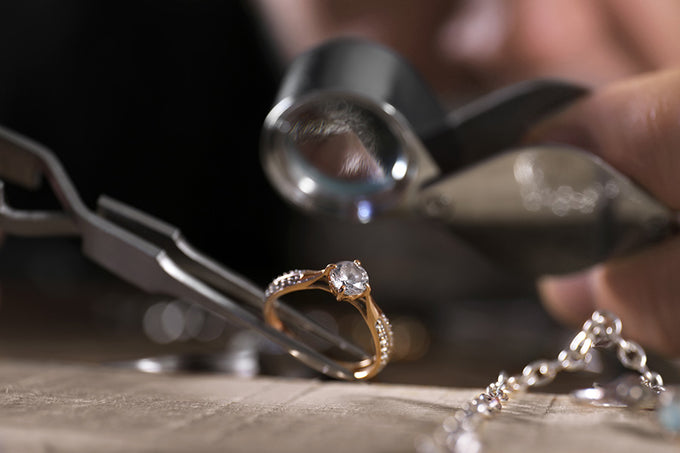
Diamond Designs has a certified appraiser and gemologist on staff. We examine your piece, take the measurements while you wait, and email the written report within seven days. Rush service is available when you need it sooner.
The most common reason people need an appraisal, and the one with the clearest purpose: establishing what it would cost to replace the piece today, so your insurer covers the right amount.
We document the piece, assign a replacement value, and help you coordinate with your insurance company.

Already have an appraisal but not sure it still holds? Insurer asking for a current one? Switching carriers?
Gold and diamond prices have moved considerably. A document written a decade ago may leave you underinsured by a wide margin without your knowing it.

Establishing the value of the jewelry in an estate, which is often the part nobody knows how to handle.
We can also advise on dividing pieces fairly between family members, which is usually the harder conversation.
Walk in during store hours or call ahead. Bring any paperwork you already have: previous appraisals, grading reports, original receipts. All of it helps and none of it is required.
The piece is examined and measured in front of you. Metal, weight, dimensions, stone measurements, cut, color, clarity, markings and manufacturing quality all get recorded.
Your jewelry does not leave the counter, and it does not leave with us.
The full document is emailed to you within seven days. Rush service is available if your insurer needs it sooner.
The report is written to be usable by an insurance company, which means it states its purpose, its basis of value and the date it was prepared, rather than just naming a number.
Describes the piece, assesses its quality, and assigns a value for a stated purpose. It covers the measurable facts, the weight, the materials and the markings, and the judgment calls, the stone quality and the standard of manufacture.
The purpose matters. A value for insurance is not the same number as a value for an estate, and neither is what a buyer would pay you today.
A laboratory document, from GIA or a comparable lab, that describes a stone's characteristics in technical detail. It assigns no value at all.
The two are often confused. A grading report tells you what the stone is. An appraisal tells you what it would cost to replace.
A common mistake is assuming an insurance appraisal is what your jewelry is worth if you sold it. It is not, and it is not meant to be. Replacement value reflects buying a new equivalent at retail. If you want to know what a piece would fetch today, that is a different conversation and we are happy to have it. See our buying and trade in page.
There is no federal or state licence required to call yourself a jewelry appraiser in the United States. Anyone can. That puts the burden on you to ask, so here is what to ask, including of us.
Contact us for current pricing. It depends on the piece and on the type of valuation you need.
The examination happens while you wait. The written report is emailed within seven days, or sooner with rush service.
No. The piece is examined at the counter and goes home with you the same visit.
Every few years, and sooner if metal or diamond prices have moved sharply. Ask your insurer what they require, since some specify an interval.
Yes. Most of what we appraise was not bought here.
Yes, and we will be clear that it is a different number from the insurance value. We buy jewelry as well, so we can give you both figures in the same visit.
Examined while you wait, by a certified appraiser and gemologist, with the written report emailed within seven days.
500 Boston Post Road, Orange, CT 06477 · (203) 799-7999
Tuesday, Wednesday, Friday 10–6 · Thursday 10–8 · Saturday 10–5 · Closed Sunday and Monday
Request an appointment© 2026 Diamond Designs